Read Make It Stick first if you want the core study methods with the strongest research behind them, for any subject from the bar to Spanish. Read A Mind for Numbers first if your problem is math, science or another technical course, and the bigger obstacle is getting yourself to sit down and work problems at all.
The real difference is who wrote them and what kind of claim each makes. Make It Stick comes from two memory researchers and a professional writer. It is built around techniques that labs have tested. A Mind for Numbers comes from an engineering professor. She explains learning through vivid brain metaphors, and some of those are useful pictures rather than findings anyone has measured.
Both books land on the same few habits: test yourself, spread practice out, and stop rereading. So whichever you start with, you are not starting wrong.

Learning How to Learn: How to Succeed in School Without Spending All …
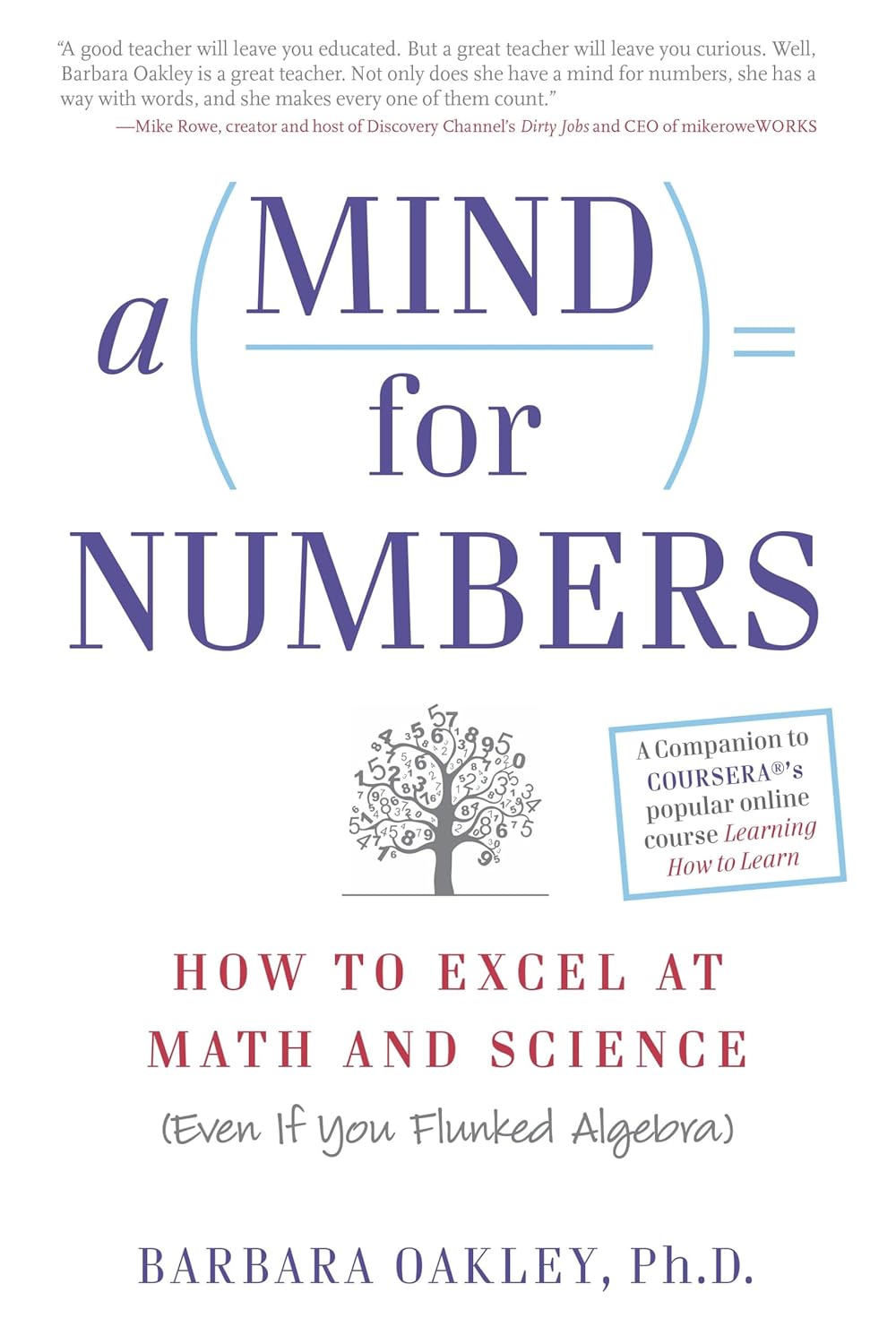
A Mind for Numbers: How to Excel at Math and Science (Even …

Make It Stick: The Science of Successful Learning
The two books side by side
| Make It Stick | A Mind for Numbers | |
|---|---|---|
| Authors | Peter C. Brown, Henry L. Roediger III, Mark A. McDaniel | Barbara Oakley |
| Author background, per ReadingGraphics | Professional writer plus two psychology professors at Washington University in St. Louis | Engineering professor at Oakland University and McMaster University |
| Publisher, per Interobservers | Belknap Press, Harvard University Press | TarcherPerigee, Penguin Random House |
| First published, per Interobservers | 2014 | July 2014 |
| Core methods, per published summaries | Retrieval practice, spacing, interleaving, varied retrieval context | Focused and diffuse modes, chunking, distributed practice, Pomodoro Technique |
| Intended reader, per Exam Study Expert | Students and parents | High school and university students |
| Placement in Interobservers' 2026 list | #1, best for research foundation | #2, best for technical subjects |
Make It Stick
Make It Stick has one argument and it states it early. In Interobservers' summary of the book, "effortful recall, not passive review, builds durable memory." Effortful recall means pulling an answer out of your own head, for example by covering your notes and writing down what you remember. Passive review means looking at the material again.
The authors matter here. According to ReadingGraphics, Henry L. Roediger III is the James S. McDonnell Distinguished University Professor at Washington University, and human learning and memory are his research specialty. Mark A. McDaniel, also a psychology professor there, is known for carrying cognitive psychology into classrooms. Peter C. Brown is the writer who turns the research into readable stories.
The book teaches three main techniques. The first is retrieval practice: quizzing yourself before you feel ready. The second is spacing: studying across several days instead of in one long session. The third is interleaving: mixing related topics in a practice session instead of doing all of one type, then all of the next. It also argues that learning which feels hard is often learning that lasts.
Learning that's easy is like writing in sand, here today and gone tomorrow.
Exam Study Expert singles out a strength other books lack. Make It Stick tells you what good studying will feel like, and the answer is often uncomfortable. That matters because rereading and highlighting feel productive. A reader who knows in advance that self-testing feels worse is less likely to drop it after a week.
The weaker side is that it gives less step-by-step help for a specific subject. If you are stuck on a calculus problem set, it tells you to space and interleave your practice, not how to break the problem down. VerTech Academy describes it as short enough to read in a single weekend.
Who should buy it: anyone preparing for an exam in any subject who wants the methods with the most research behind them, and who would rather understand why they work than be talked into them.
Make It Stick: The Science of Successful Learning
A Mind for Numbers
A Mind for Numbers is a coaching book for people who think they are "not a math person." VerTech Academy notes that it is framed around Oakley's own story of once failing at math and science. ReadingGraphics lists 18 chapters covering learning, memory, procrastination and exam preparation, with exercises and anecdotes from students and professors.
Its signature idea is two modes of thinking. Focused mode is concentrated, step-by-step work, which Oakley compares to shining a strong flashlight beam in the dark. Diffuse mode is the relaxed, wandering state you are in on a walk or in the shower, when loose connections can form. According to Bagerbach's notes, she says you cannot be fully in both at once, and that diffuse mode only works on material you have already wrestled with in focused mode. Her line for this: "The diffuse mode must have clay to make bricks."
The practical payoff is real for technical subjects. The book gives a seven-step routine for building a "chunk," meaning a concept practiced until it fits together as one connected idea. The steps are: solve a problem fully, redo it with attention to the key steps, take a break, sleep on it, redo it again, add a related problem, and practice recalling it away from your desk. It also treats procrastination seriously and recommends the Pomodoro Technique: 25 minutes of focused work, then a 5 to 10 minute break.
The book also leans on self-testing. Bagerbach's notes describe simple recall, testing yourself without looking at your notes, as one of the most effective aids to chunking. That is the same core method Make It Stick is built around.
Two related resources come up in the same breath. Interobservers reports that Oakley's work is tied to a free Coursera course, Learning How to Learn, co-developed with neuroscientist Terrence Sejnowski of the Salk Institute. Oakley also has a book called Learning How to Learn. Exam Study Expert places it at middle school and below, and A Mind for Numbers at high school and university. A teenager in high school can go straight to A Mind for Numbers.
Who should buy it: a high school or college student, or a self-taught adult, struggling with math, physics, chemistry or engineering, especially one whose real problem is avoiding the work.
A Mind for Numbers: How to Excel at Math and Science
Learning How to Learn: How to Succeed in School Without Spending All Your Time Studying
What separates them, once you look past the overlap
The source of authority. Make It Stick's authors study memory for a living, so its main claims rest on research. Oakley is a respected engineering educator writing from her teaching and her own experience, with neuroscience as illustration. Neither is dishonest. They are making different kinds of claim, and you should give the focused and diffuse idea less weight than spacing or self-testing.
How far the shared core reaches. Both books push spaced practice, and that part is strongly supported. A 2026 meta-analysis in The Clinical Teacher by James Maye and Florence Hurley pooled 13 studies covering 21,415 medical learners. A meta-analysis combines many studies into one estimate. They found spaced repetition beat standard study by a standardized mean difference of 0.78, which roughly means the average spaced learner outscored about three-quarters of a typical spread of their peers' scores. A separate review of nine randomized trials in Nurse Education Today found a retention effect of 0.62. Both reviews studied health-professions students, so they do not prove the effect is the same size for every subject. On that shared ground, the two books agree, and both are right. Spacing and practice testing also hold up well in the wider research on systems like Leitner boxes.
Subject fit. For memorizing a large body of facts, such as vocabulary, case law or anatomy, Make It Stick's retrieval-and-spacing framework is the whole job. For problem-solving subjects, Oakley's chunking routine and anti-procrastination tools fill a gap Make It Stick leaves open.
Our sources did not publish a September 2026 Amazon price for either book, so this comparison does not weigh cost. The sources also don't detail which studies each book cites, so we cannot compare their reference lists directly.
Which to read first
Most readers should start with Make It Stick. It gives you the methods with the best evidence, explains why they feel harder than rereading, and applies to every exam. Interobservers and VerTech Academy both put it first for the same reason.
Start with A Mind for Numbers instead if two things are true: your subject is math, science or engineering, and you keep putting off the problem sets. Its Pomodoro routine and chunking steps will get you working tonight, and it teaches self-testing and spacing along the way.
If you read both, read Make It Stick first and treat Oakley's book as the field manual for technical courses. When her metaphors and the research disagree, go with the research.
Comments
No comments yet. Be the first to comment!
Leave a Comment